
-
Mathematical Vocabulary- Part 2

In my last vocabulary blog post I discussed the need for teachers and students to use proper mathematical vocabulary. I referenced the 8 Standards of Mathematical Practice and how communication is key in students making sense of problems, reasoning abstractly and quantitatively, constructing viable arguments and critiquing the reasoning of others, and modeling with mathematics. The 8 Standards of Mathematical Practice leads us to attending to precision as mathematicians. If you have not read that post, I highly encourage you to start there.
Today’s blog post is going to focus on the vocabulary teachers and students need to be using when it comes to place value. I am going to try my best to not bring computation strategies into this post, as I will focus on the vocabulary with computation in another post. Stay tuned for that.
As a teacher who taught in the intermediate grades for 15 years, I was constantly trying to tie what we were working on in 4th grade back to what my students knew from kindergarten through 3rd grade. That’s a common idea, make connections to their prior knowledge. One thing I did that made a HUGE difference in my student understanding was how I spoke about numbers. I started using unit form more regularly and I noticed a huge change in how my students were able to manipulate their numbers and build their number sense.
An important thing for students to be able to do is to name numbers differently. If students don’t have a strong number sense, they struggle to be able to see the various ways numbers can be named or decomposed. If we show students the number 170, many of our students see this as one hundred seventy. Few students see this number as seventeen tens. If we start to introduce unit form to our mathematicians, we can help them build a stronger number sense from whole numbers to fractions and decimals.
One of the best ways we can build this number sense is through the use of manipulatives. I’ve had many students struggle with the idea of renaming of numbers and getting out base-ten blocks has been my key to success. We start by having the students show me 1 ten and I ask them what the value of one ten. They look at me like I’m crazy and say, “ten.” I write that out as 10. Then I ask them to show me 2 tens. They have two tens in their hands and I ask again, “What is the value?” They humor me and say, “Twenty.” I write out 20. We keep this going until we hit 90. When all of the numbers are written out, like below, I ask them, “What do you notice?”
- 1 ten = 10
- 2 tens = 20
- 3 tens =30
- 4 tens = 40
- 5 tens = 50
- 6 tens = 60
- 7 tens = 70
- 8 tens = 80
- 9 tens = 90
I’m looking for the students to respond with, “Every ten ends in one zero.” When I get that answer out of them, I underline all of the zeros that the tens end in. We then keep going.
- 1 ten = 10
- 2 tens = 20
- 3 tens =30
- 4 tens = 40
- 5 tens = 50
- 6 tens = 60
- 7 tens = 70
- 8 tens = 80
- 9 tens = 90
- 10 tens = 100
- 11 tens = 110
- 12 tens = 120
- 13 tens = 130
- 14 tens = 140
As I write this out for the students to see they really start to notice the pattern. I will then skip ahead and ask them, “What’s 17 tens?” Once they have seen the pattern of every ten ends in 1 zero, they really catch on and can use what they now to know that 17 tens = 170.
We carry this same idea on for hundreds. We start again by having the students show me one hundred block and I ask, “What’s the value of one hundred?” They start to predict where I’m going and reply, “One hundred.” I write that out as 100. Then I ask them to show me two hundreds. They have two hundreds in their hands and we repeat the process. “What is the value in your hands now?,” I ask. They tell me, “Two hundreds.” I write out 200. We keep this going until we hit 900.
- 1 hundred= 100
- 2 hundreds= 200
- 3 hundreds=300
- 4 hundreds= 400
- 5 hundreds= 500
- 6 hundreds= 600
- 7 hundreds= 700
- 8 hundreds= 800
- 9 hundreds= 900
Again, I ask, “What do we notice about every one of our hundreds?” I’m looking for the students to respond with, “every hundred ends in two zeros.” So we keep going.
- 1 hundred= 100
- 2 hundreds= 200
- 3 hundreds=300
- 4 hundreds= 400
- 5 hundreds= 500
- 6 hundreds= 600
- 7 hundreds= 700
- 8 hundreds= 800
- 9 hundreds= 900
- 10 hundreds= 1000
- 11 hundreds = 1100
- 12 hundreds = 1200
- 13 hundreds = 1300
- 14 hundred = 1400
I will then skip around and ask for the value of 28 hundreds, 42 hundreds, 113 hundreds, and so on. We talk about how we can say 42 hundreds as four thousand two hundred or forty-two hundred. The same number can be seen and said in multiple ways. This is very important when our students get into multi-digit multiplication and division.
We then use what we know about tens and hundreds and make the connection to thousands. As we start to write out the value for various amounts of thousands, the students notice that every thousand ends in 3 zeros. I give them more complicated thousands to write out and they really enjoy using the ideas that they discovered of every ten ends in 1 zero, every hundred ends in 2 zeros, and every thousand ends in 3 zeros. When students discover ideas and concepts, when we give them time to be curious and wonder, we allow them the space and opportunity to develop ownership of that idea.
Using unit form is helpful in other situations as well. For instance, with the number 3,427. One of the standards across grade levels is to write this number in standard form, expanded form, and word form. What’s missing in this is unit form. Instead of only expecting…
3,826 = three thousand, eight hundred twenty-six = 3000 + 800 + 20 + 6
I actually saw this exact concept just this week in a 3rd grade intervention classroom I stopped in. There is absolutely nothing wrong with this. I would just like to see the unit form added to the various forms as it will lend to making more sense to students.

We can have our students also thinking in terms of units also, which leads us to students combining like units when they get into 6th grade and up. Start with me here.
3,427 + 2,160 =
3 thousands, 4 hundreds, 2 tens, 7 ones + 2 thousands, 1 hundred, 6 tens, 0 ones =
We are going to combine “like units”… thousands with thousands, hundreds with hundreds, tens with tens, and ones with ones. There may come a time where we need to regroup or bundle within our problem, but to start, we need to really focus on the concept of naming our units and combining like units.
3 thousands + 2 thousands = 5 thousands
4 hundreds + 1 hundred = 5 hundreds
2 tens + 6 tens = 8 tens
7 ones + 0 ones= 7 ones
5 thousands 5 hundreds 8 tens 7 ones = 5,587
This allows our students to be using place value vocabulary. As I mentioned, this leads us to some algebraic standards in middle school when students have to start combining like terms or units.
3x + 5y + 7x + 6y =
The x’s and y’s are like our tens or hundreds.
3x + 5y + 7x + 6y
We combine like units.
10x + 11y
This is another computation strategy, partial sums. There are many different ways to show mathematical work for partial sums, but essentially that’s what we are doing, . We are decomposing the problem, or breaking the problem down into parts. We are then putting the parts together to find the whole.
We can do the same thing with decimals. Let’s try 1.578 – 0.346. Here we are still going to write our number in unit form and combine like terms/units… only this time we are subtracting and will be finding partial differences.
1.578- 0.346=
1 whole 5 tenths 7 hundredths 8 thousandths – 0 whole 3 tenths 4 hundredths 6 thousandths
1 whole – 0 whole = 1 whole
5 tenths – 3 tenths = 2 tenths
7 hundredths – 4 hundredths = 3 hundredths
8 thousandths – 6 thousandths = 2 thousandths
1 whole 2 tenths 3 hundredths 2 thousandths = 1.232
My favorite part of naming units comes into play when we are talking fractions. Every year when I am in the second day of school and during our Daily Number Sense Routine working with our “Fraction of the Day” we are adding 1/2+1/2 . The misconception with students is that 1/2+1/2=1/4. I actually love when a student gives me this answer. I love when students give me wrong answers. It allows me to have a teachable moment. In this instance, I wrote this out on the board.

I then ask them, “ What are we counting in this problem?” It’s the second day of school, so they’re all looking around at one another. Sometimes a brand new 4th grader will say that we are counting halves, but not all of the time. I then tie it back to something they did back in kindergarten and I grab a few of those plastic bears all of our primary friends have.
I count them out.

1 bear + 1 bear + 1 bear + 1 bear + 1 bear + 1 bear = ?
I’m hoping they say 6 bears. I ask them what we are counting and they say bears. I then refer back to our fraction sentences.
1/2+1/2 = 1 half + 1 half = ?
At this point they usually catch on and tell me 1 half + 1 half = 2 halves. It also helps to have the image of the halves colored in so they can see this circle is not cut into fourths or 4 parts. The circle is cut into halves or 2 parts, with both of them shaded in.

I go on to talk about how the number we are saying is the adjective (descriptive word) and the unit is the noun (the thing we are counting). I created these Fraction Vocab cards for fractions to hang in my room and talk about the fraction piece a little further in this blog post on my friend Kristin’s site.
I know I said I wouldn’t get into computation, but when we are naming units, it’s an easy transition into how we are working with students and computation strategies. My next vocabulary post will be more focus on students understanding that as we move to the left on the place value chart we are multiplying by 10 and when we move to the right we are dividing by 10. Stay tuned!
-
Comparing Numbers: Who has more? Who has less?

Take a few minutes to watch the video below that shows you a great game/activity you can quickly show your students and have them playing immediately.
Who has more? Who has less? works on comparing and ordering numbers. This game can be differentiated and played from kindergarten all the way through 5th grade.
If you have your students playing this game, please share or tag me in your photos. #kappelconsultingllc #makemathmeaningful #thinkfreeklyandflexibly
Who has more? Who has less? – Download
Box Cars & One-Eyed Jacks– I searched “shakers” on their website and here is what came up.
Here are a few other ways you can have kids using tools to practice comparing numbers.

 Here you can see students using square inch tiles that I have written out the digits 0-9 on. Depending on how many digits you are working with, students have their tiles face down and grab that many. In this case, my students were comparing 5-digits numbers. They then had to create a number and compare. You can see the students pointing to the place value that they used to compare their numbers.
 Here you can see students are using a recording sheet from my friends at Box Cars & One-Eyed Jacks to shake, record, and compare numbers.
 -
Mathematical Vocabulary Part 1

I often reference the 8 Standards of Mathematical Practice when I am working with teachers. Regardless of the set of standards your school or district utilizes, the vast majority also include the Standards for Mathematical Practice. Mathematical Practice Standards are separate from content standards. The graphic below gives us an easy to understand breakdown.
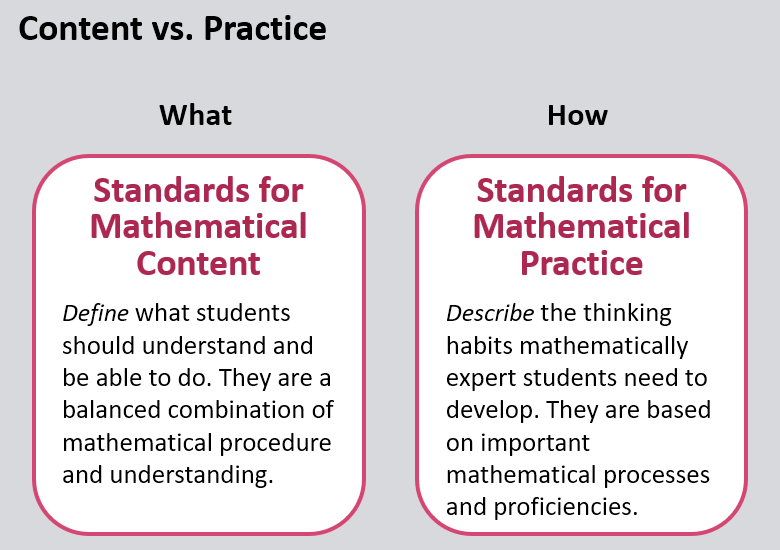
The state of Ohio’s education site says, “The Standards for Mathematical Practice describe the skills that mathematics educators should seek to develop in their students.”
Per the site, CoreStandards.org , the Mathematical Practices are defined as,
“The Standards for Mathematical Practice describe varieties of expertise that mathematics educators at all levels should seek to develop in their students. These practices rest on important “processes and proficiencies” with longstanding importance in mathematics education. The first of these are the NCTM process standards of problem solving, reasoning and proof, communication, representation, and connections. The second are the strands of mathematical proficiency specified in the National Research Council’s report Adding It Up: adaptive reasoning, strategic competence, conceptual understanding (comprehension of mathematical concepts, operations and relations), procedural fluency (skill in carrying out procedures flexibly, accurately, efficiently and appropriately), and productive disposition (habitual inclination to see mathematics as sensible, useful, and worthwhile, coupled with a belief in diligence and one’s own efficacy).”
You may notice some familiar words. This is where my favorite thing to tell students comes from.

We could spend a blog post on each of the 8 Practices, but many people already have. Some of my favorites are:
- Robert Kaplinsky : Robert attempts to rewrite the Mathematical Practices in a way that educators, parents, and students can understand them.
- Mike Flynn: Mike wrote a book to help educators gain a clear picture and to understand the 8 Standards of Mathematical Practice and how to implement them in a K-2 classroom. I’m sure what he has in this book can also be very helpful in a 3-6 classroom as well.
- Sarah VanDerwerf: Sarah is such an inspiration for those who follow her. She does such a great job of showing teachers in all grade bands things they can do in order to get students to acknowledge and believe they are mathematicians. This particular post always has me thinking about what I do with students and teachers.
Instead, I am going to focus on the vocabulary piece. Content standards are full of mathematical vocabulary and can often be confusing to both teachers and students. When do we use content-specific vocabulary? When do we use student-friendly vocabulary? How and when do we blend both together? When we talk about vocabulary we are asking our students to work within a few of the Mathematical Practices.
MP1: Make sense of problems and persevere in solving them.
MP2: Reason abstractly and quantitatively.
MP3: Construct viable arguments and critique the reasoning of others.
MP4: Model with mathematics.
MP6: Attend to precision.
Let’s break the Mathematical Practices down and how they relate to vocabulary.
MP1: Make sense of problems and persevere in solving them.
- Students need to be able to comfortably show their thinking in their work. Sometimes students will have to read or work through difficult problems. Students need to understand problems conceptually in order to apply their problem-solving strategies. Understanding and applying the proper vocabulary is critically important.
- When students make sense of problems, they are thinking contextually about problems, not procedurally.
- We need student dialogue and good questioning from the teacher to encourage “making sense” of the problem.
MP2: Reason abstractly and quantitatively.
- If students can understand what the problem before them is telling them and asking them, then the child is demonstrating an understanding of the mathematical concepts presented. Subsequently, this means the vocabulary involved is understood. Students are able to then apply or remove their own personal connections to a specific situation when they understand the idea behind the problem.
MP3: Construct viable arguments and critique the reasoning of others.
- Asking open-ended questions which require students defend their answers, sets the expectation that students use proper mathematical vocabulary. Whether the student is respectfully agreeing or disagreeing with an answer or another student’s thinking, using mathematical terms needs to be expected.
- As teachers, we need to be using the same vocabulary we expect our students to use.
- Asking students to show or verbally give proof of their thinking, is a direct connection, and reinforces, many language arts skills.

The state of Ohio has some great PowerPoints that walk us through the 8 mathematical practices.
MP4: Model with mathematics.
- Student-centered mathematics is when a learner defends or models their thinking of a problem.
- Communication is essential in order for the concept to be understood by all students involved.
MP6: Attends to precision.
- Students need to first understand the question in order to be precise with their answer. If students do not understand certain words in the problem, either the information they are given or the question being asked, students will struggle to work through the problem.
Big picture to keep in mind: if we are going to expect our students to use the proper vocabulary, we need to be using the proper mathematical vocabulary as well. I look forward to sharing ideas with you on how to keep all this in mind, as we will walk through vocabulary with place value (whole numbers and decimals), fractions, and computation within the next 3 weeks.
-
Mathematical Environments in Your School – Part 1

How is math learning showcased in your building?
Does each teacher put up their own displays?
Do you have building-wide displays for visitors to view?
Kristin and I love walking into buildings where you can see the learning taking place before you ever enter the classroom. Just today I saw these hanging in the hallway at a school I was working at and had to stop and snap some pictures. It made me smile so big.


Over the years I have worked hard to improve what I put up in the hall outside my room, but I’m always looking for ways to get the rest of the building involved. Last year I finally found something new that both teachers and students are loving–
Math Picture Puzzles!


I found these types of upper elementary puzzles from Jennifer Findlay. I give a pack to my students at the beginning of each month and they’re due at the end of each month. At the start of the school year, my 4th graders typically find them quite difficult, but as the year goes on they learn strategies that make them easier to solve. They are great for practicing mental math and algebraic connections. I like having my students solve them on paper, but during the COVID online learning, I had my students complete them on Kami via Google Classroom, so if you’re remote or an online teacher, this is a great option to look into.
Last year I decided to take the puzzles a step further and post them in the hallways for all students in the building to enjoy. I use two different levels, K-2 and 3-5. This doesn’t mean that K-2 students cannot complete the 3-5 puzzles. I just made the K-2 ones a little more friendly for our younger friends. Below you can see how a 1st grade class in my building sat outside the puzzles in the hallway to solve together. They ended up solving two of the upper-level puzzles as well.
 Solving these picture puzzles, students will use their knowledge of addition, subtraction, multiplication, and division. Depending on what you want your students working on, stick with those operations. Students will problem solve and make connections from what they already know to what they don’t know. The puzzles give students an opportunity to work on their fact fluency without the pressure of a timed test. The puzzles are themed for the month, so solving them tends to be a little more fun for students.
I placed the puzzles in a high traffic area of the building. As every class leaves our cafeteria they walk right to the wall where the math puzzles are posted. As I’ve been in the hallway, I’ve heard students whispering to one another, “The snowflake must be 6 if three snowflakes equal 18.” It makes me smile so big and fills my math heart right up!


After the 1st graders mentioned above came and solved the math puzzles as a class, they were so excited to get started on their math lesson. I was talking with the teacher after school at our staff meeting and told her it would be cool for her students to create their own Math Picture Puzzles. She told them the next day I said that and they couldn’t wait to get started! I cannot wait to see what they come up with!
I am sharing my file of hallway picture puzzles with you. It will force you to make a copy of the file, so you can continue to create more puzzles if you’d like. I plan on changing out the puzzles in the hallway at my school every other week to keep the kids thinking. Let me know if you use them and how it goes! I love receiving pictures from teachers on what they are doing and creating for their students.
-
Student Ownership of Their Learning
Happy Monday friends!!
I’m a planner at heart. I have way too many wheels moving to not have a color-coded calendar or to not meal plan. Like a lot of us, I am juggling a lot of different balls every moment of every day. I have to-do lists out the wazoo, which includes a written out plan for blog posts to push out. This week, the focus was supposed to be focused around the use of mathematical vocabulary in our classrooms. I have 3 planned to come out this week as I don’t want to wait 3 weeks to get them out to you. The first one is written and ready to go, but something else jumped on my heart this morning and I have to get that out first.
For those of you who don’t know me personally, I love country music. It’s pretty much the only music I listen to. At a wedding this weekend, I knew none of the pop music. I’m just not that cool. Every day I listen to the Bobby Bones Show and go about my business of getting the kids ready for school, cleaning, or working at my desk on things related to how educators can Make Math Meaningful. I enjoy the positivity and laughter that the Bobby Bones Show provides and it’s clean, meaning… I can listen to it around my kids. Bobby has guests on weekly and does a great job asking not so typical questions in his interviews.
This morning I was listening to this past Friday’s episode which happen to have Kathie Lee Gifford on. I was standing at my kitchen sink washing dishes by hand as my dishwasher was loaded to the brim from the weekend. (We had 6 soccer games this weekend to attend and a wedding out of town. We were busy.) Anyway, Kathie Lee Gifford was the guest and Bobby was interviewing her. She was speaking about her father and how he wanted her to earn her way in life and to learn hard work. She said her daddy told her this and it really struck me. I literally stopped washing the dishes. Dried my hands. Paused the podcast and went over to a pad of paper. I backed the podcast up a bit so I could write out word for word was Kathie Lee said. Her dad told her, “I love you too much to deny you the privilege of making mistakes. Be willing to, because that’s the way you’re going to learn almost everything you’re going to need to know.”
Wow!! Isn’t that great advice. Her father loved her enough to have her learn lessons on her own. He didn’t want to make her path easy for her. He knew that she needed to learn things in her own time and in her own way.
Let’s think about how we can take this same idea to the math classroom. When we, the teacher, tell our students a rule or a procedure that’s just another opportunity of the adult telling the child what to do and how to do it. The ownership is in the hands of the adult. When students are put in a situation where they discover something… Where the student has the start of a lightbulb moment… When a student starts to make the connection to something they already know… The discovery of mathematical concept is the key to unlocking learning and potential. If we take that opportunity away from our students, we are taking away their ownership of their education. We are taking control away from them and putting it back in our hands. Allowing students to struggle, progressive struggle is important in their learning and growing. Without struggle there is no growth. It is our job to set students up in situations where they are in a community where they feel comfortable and brave enough to risk being wrong.

This is a saying that was posted in my class for years. I’m always challenging my students so they can grow, not only as mathematicians, but as readers/writers/scientists/thinkers and human beings. If we pause a little bit more. If we ask, “How do you know that?” a few more times. If we allow students to COMMUNICATE with one another and ask them to use REASONING and PROOF, imagine the learning that can happen. If we expect MULTIPLE RESPRESENTATIONS and MODELS and for our students to PERSEVERE through hard moments, imagine the type of thinkers we are growing. Asking students to think about their thinking and looking for PATTERNS and CONNECTIONS to help give them a boost when they are stuck, they gain ownership of their learning. They take control of their education. When we ask students to think critically about their math, we are asking them to be PROBLEM SOLVERS. We are asking them to be mathematical thinkers, not just doers. If these words sound familiar to you, they should. This is all language from the 8 Standards for Student Mathematical Practices.
Are there going to be hard moments when we shift our teaching to support their learning. Absolutely. It’s not an easy thing to do, sit back and allow the progressive struggle. I promise if you do and if you encourage your students to THINK FREELY & FLEXIBLY you will see the growth right before your own eyes. If you take few extra minutes each day to let more students SHARE THEIR THINKING, you’ll see they will catch their own mistakes. They’ll be able to help a few other classmates start to make the connections. I know that time is short, but from my experience if we can slow down throughout the first semester of the year, it allows up to speed up later in the year after we have established these norms in our math classrooms.
My question to you now is, how can you not allow your students to struggle? You as their teacher need to show them what to do when they’re “stuck”. What does that look like and sound like. What steps can they take when they aren’t sure what to do next. Be their guide. Be their leader. But also, let them struggle. You’ll be amazed as to what they’ll be able to do by the end of the school year and how much growth they will make.
If you’re looking for more on how to create this vibe in your classroom, take a few minutes to read through Creating a Math Community.
-
Creating a Math Community

Friends, it’s the time of year that teachers are thinking about the return to school or you’re already back and in the swing of things.
First, I want to wish each and every one of you a great school year!
I know that a lot of you that follow me here at Make Math Meaningful do not just teach math. Some of you teach all contents or maybe math and one other subject. Either way, ideas you’re about to read through are not just for mathematics. These ideas can be connected to all subjects.
As you’re beginning the 2022-2023 school year you are starting to build a family within the walls of your classroom. From my experience in education over the last 17 years, all teachers want to build a love of learning in their students. We want our students to believe in themselves, no matter their circumstances outside of the school building. We as teachers want to create a space that everyone feels welcome and accepted. We want to create a space that all students can learn.
When it comes specifically to math, we may need to take some extra steps to create a positive math experience. Too often adults put a sour taste in our youngest mathematicians mouths by the things they say. Things such as, “I’m not a math person.”, “Math is not my thing.” or “Math is hard.” These negative things that are said by adults in front of students is not ok. One of the first things I do every year is to get ahead of these negative comments by letting the parents know that we need to keep the negative comments at bay. We don’t want to put those thoughts and feelings on their children. I do this through parent newsletters or by hosting a parent math night where I lay out the road map for our year and how I teach math differently to reach all learners and allow my students to think freely and flexibly about numbers to build their number sense. I haven’t had a parent yet leave my parent math nights continuing to think it’s ok to “not be a math person.”
The ever popular “Growth Mindset” idea that has blown up over the last 5 or so years helps with keeping the negative thoughts stay away. Reminding students that maybe they don’t know how to do something YET is very important. If you have not read Limitless Mind by Jo Boaler, I highly recommend it. The entire book goes through various stories and ways we can encourage our students to have a growth mindset vs. a fixed mindset. Boaler uses evidence from scientific evidence and hundreds of resources to make her points about how the brain is adaptable and we are able to continue to mold and change it. Talking with students about how their brain works and how they can create and strengthen their neuropathways helps them understand how learning works, which leads to ownership of their own education.


Another thing I do with my students is to create a T-chart with them about what we want our Math Community in our classroom to look like and sound like. We want to establish early on what it looks like and sounds like for the following ways mathematicians act:
- State WHY and HOW we came to our answers using reasoning and proof.
- Using our math tools to learn in class.
- Communicating respectfully and responsibly when we disagree with a classmate’s answer.
- Make connections to what we already know.
- When we get to a block in our thinking road, what can we do and how can we find a detour instead of shutting down.
As the teacher, it’s your job to model and teach the expectations for your students in your classroom. I always had such a fun time modeling with any of my co-teachers what all of the above looks and sounds like, and what they should not look or sound like. The kids always got a kick out what certain actions do not look or sound like. Our little show gave them something to remember when it came to our expectations.
Did anyone notice that the bullet points above are most of our 8 Mathematical Practices? It’s not a coincidence. Helping your students understand the expectations of the 8 Mathematical Practices at the given grade level is something that needs to be happening with any set of standards you are teaching. If you’re looking for an easy to understand poster to hang up or recreate, below is my favorite. This particular poster puts the long explanation of the 8 Mathematical Practices into some basic, easy to understand words. You can download it here.

8 Mathematical Practices I have many people ask, “What’s the difference between our learning standards and the 8 Mathematical Practices?” I love to share the image below with them. The biggest difference is the learning standards tell us WHAT needs to be taught. The Mathematical Practices help students understand what skills they need to use to understand and express the learning standards.

Learning Standards vs. Mathematical Practices Math is not always as black and white as it has thought to be. Demonstrate and encourage your students to work their way through the 8 Mathematical Practices to think FREELY & FLEXIBILY about math. We want students to have ownership of their own education inside the math community you are building in your classroom. Encourage students to be brave in sharing their thinking when it comes to problem solving. This poster has been hung up right outside or inside my classroom for years and years. I want students to always remember to think freely and flexibly in our math community.

-
What is a mathematician?

To be honest, if you asked 100 different people you may get 100 different answers.
What is a mathematician?
For me this is a simple question. For students, this is quite tricky.
At the start of every school year, for the past 9 or so years, I have given this question to each of my classes within the first few days of the school year.
The assignment is two-fold.
- I want to know what they think of math. Who does math? What does a mathematician look like? How does a mathematician think?
- Their ELA teacher and I gained an understanding of their writing at the start of the year.
I hand the paper out and I ask them, “What does a mathematician look like? What does a mathematician do? How to they think? What makes someone a mathematician.” They are asked to use the top part to draw me a picture of a mathematician and use the lines to write me three or more sentences answering these questions.
As you can imagine, some students are looking around dumb-founded and not knowing what I’m looking for. Some students ask me, “What’s a mathematician?” I reply, “Sweetie, that’s what I’m asking you. Look at the word and see if you can use your prior knowledge or connections to tell me what you think.”

This assignment is NEVER for a grade, but just a way for me to see how they feel about math in general. About half of the time students draw pictures of Albert Einstein or a scientist. The other half of the students draw a picture of a classroom with a teacher at the board and students in desks. The teacher is the only one with the text bubble by their head talking. When the students write about a mathematician they say things like, “a person who does math fast” or “a person who does math all the time.”
Take a look at some examples from over the years.


After about a week or so of me encouraging them to think like mathematicians (making connections to their prior knowledge), to talk like mathematicians (use mathematically correct vocabulary), and listen like mathematicians (listen to learn, not to respond). As I teach, I give them examples of what I may be thinking or how I answer questions with the language I choose, do they start to get it. I tell them that they are each mathematicians and they look at me like I have 3 heads.
When I explain that a mathematician is simply someone who studies math, they look around and shake their knowingly. When I say that my goal by the end of the year is that they can look in the mirror and see themselves as a mathematician I have achieved my goal. They shake their heads and smile by this point.
Throughout the entire school year they hear me say things like,
“Great job thinking like a mathematician!”
“You’re doing a terrific job talking like a mathematician!”
“When you look in the mirror what do you see?” Their response, “A mathematician!”
No matter what level our students are at they need to believe they can do math. They need to believe they can continue to grow and achieve. We need to model what mathematicians do, which is being a PROBLEM SOLVER. To be a problem solver we need to show and teach our students how to be problem solvers. The image below is one of my favorite images and one I use a lot when working with teachers and students. To be a problem solver we need to be able to communicate our thoughts by using multiple representations and models to prove our thinking with reasoning and proof, all while making connections to what we already know to be true. These are 4 of our 8 Mathematical Practices that help us drive how we teach our content standards.

By the end of the year we want our students to think of themselves as mathematicians. In order to see how my student view themselves, I give them the same exact assignment again, hoping they draw a self-portrait and see themselves as mathematician.


My daughter and her friend, both 2nd graders at the time, answered this question for me. Their responses are:
- Daughter: “A mathematician is someone who is really good at math and knows a lot. They memorize the numbers and put them together in their head. They think by looking at the numbers and adding and subtracting all of the answers in their head.”
- Daughter’s friend: “A mathematician is someone who knows a lot of math and helps lots of people do math and they think math-like. Some problems they use math in them.”
When the girls finished, I asked them if they wanted to see a real life mathematician. They both excitedly said, “Yes!” I turned them toward the window and they saw their reflection. They both smiled huge smiles and said, “I see me.” I asked them, “Do you do math? Do you explain or show your thinking? Do you make connections to what you already know when solving something new? Can you solve a problem in multiple ways?” When they smiled and said, “Yes, I show my work.” I told them they were mathematicians and they both puffed their chests a little bit and stood a little taller. They felt good!
The same exact thing happens with students in your classroom!!!
This assignment is not limited to elementary. I’d be interested to see what middle school and high school students put when they get the same exact assignment. If you have your students complete this assignment, please let us know how it goes! I LOVE hearing how your students do on the activities we share with you!
-
I am here for you…
With districts across the United States starting school or getting ready to start school in the next month I wanted to make my intentions clear, I AM HERE FOR YOU!
Yes, you!
If you’re here reading this, you are probably an educator of sorts. You could be a teacher in a traditional setting or a homeschool parent teaching your children from home. You could be a district administrator looking for ways to help the teachers in your district teach math better. You could be a math coach in a district in search of activities or ideas you can take back to your staff to help the students in your district to understand their math standards better. You could even be a parent reading this. I have parents come up and ask me all the time in the basketball gym or at the soccer or lacrosse field about the “new math” or they’ll tell me about the struggles their children are having in math class. If you are any of those people or if you’re in a different role, my purpose is to help you.
When I started this website and my company, the goal of MakeMathMeaningful.com and Kappel Consulting LLC is exactly that- I want to make math meaningful for teachers, students, and parents. Too often I hear about test scores and people not being “math people.” I hear adults say, “I memorized my facts, what’s wrong with how we were taught?” I just don’t accept that. Using the excuse of , “I was taught…” doesn’t cut it. If you’re in education you know test scores are a big deal with how districts are graded. It is my opinion, test scores take care of themselves if we do our jobs and teach students for conceptual understanding, not for scores. Students don’t dislike math, they dislike how not understanding something feels. Students dislike feeling confused and not being able to make sense of concepts.
Throughout the course of my career I have sought out opportunities to continue to learn, grow, and understand the connections between the various ideas and concepts in mathematics. I have had so many of my own lightbulb moments, I want to share what I’ve learned with other educators so they (you) can have those same lightbulb moments and then you can set your students up for those exact moments as well.
Over the next few weeks as schools begin to open their doors for the 2022-2023 school year I will be sharing with you some of my very favorite activities I have done for years with students to get to know them as mathematicians. We need to know where they are mathematically, how they feel about themselves as a mathematicians, and what connections they can make within their knowledge of mathematics. What we choose to do with our students very early on in the school year sets the tone for your math block this year. Make your choices carefully.
You can always reach out to me with any questions you have or if you are interested in working together.
I have some ideas and things ready to send your way, but if you’re looking for something specific, don’t hesitate to reach out and ask.
I’ll leave you with this… A few years ago I came across this Name Tent idea from Sarah Van Der Werf. It was a great way to get to know my new students on Day 1 of the new school year, especially the shy students who need time to show their true self to a new adult. Don’t let the talk of high school math classes scare you in her blog post. Instead, focus on the idea behind the name tent. This is a chance for you to get pretty quick feedback from students and a chance for you to reply back to them. Primary teachers: maybe you ask your students how their first days was and they pick an emoji to draw from options on the board that stand for Great, Good, Ok, Bad. Intermediate, your students can write you a little comment or answer a question to propose. Last year I created my own version. Below you can download and print onto white cardstock paper and have your students create their own name tents. They simply fold in half with the printed part on the inside and write their name on one side of the blank side.
-
Brownies with Fractions

Any one who knows me personally knows I love to cook and I love math. It’s even better when I combine the two!
Maybe you’re like me and like to have a little bit of fun when you cut your brownies?
My kids know what’s coming when I have one of them come over when I start to cut brownies or bar cookies… a math talk!
As I made each cut in this 8” x 8” pan of brownies my son and I had a conversation. Let me walk you through the questions I asked him. When I do this with students in my class, they each have a few post-it notes to try this out conceptually.

Let’s start by cutting this into halves. How many equal parts should be make to be halves? Show me which way you would like me to cut them to make halves. 
Great! So we have halves. What happens if we can each of these halves in half? How should we cut each of them in half? 
Here’s where I had my son close his eyes and when he opened them I had the brownies cut like this. I asked him, “Are these the same size? What are the parts?” Me cutting the brownies like this made his brain go bonkers, but as we talked it through he came to find that each of these parts were equal and fourths. My son got on board and helped me decide how we cut each of the fourths in half. Before we did the actual cut, he had to predict how many parts there would be. I was trying to get him to see the pattern. *This is the point in which my class of 4th graders were confused that the triangles on the right side were congruent to the rectangles on the left. I had to go back and picture in class and draw on the board cutting the fourths in half. 
We then made horizontal cuts in the brownies and talked about which pieces were congruent and which were not. More importantly, we talked about WHY the pieces weren’t congruent. My son said we needed another cut.. 
L made additional diagonal cuts on the right to create these different sized triangles. This gave us the opportunity to talk about congruent parts of the brownies. The squares on the left have the same area as the larger triangles on the right, but it takes 2 of the smaller triangles on the right to equal the left. It was a great discussion in class as well. I have provided you with a handful of images below that I have used in my own classroom to have math talks with my students. Sometimes I put up an image and give them a few minutes to jot down notes and chat with their group about what math they see and other times I pose questions to them. Either way, it’s an easy and fun way for students to engage with math in the real world.
Please help yourself to the free downloads below of food fraction pictures you can use in your classroom.
-
Welcome to Make Math Meaningful!!

I am so excited to welcome you on this journey of making math more meaningful, for not only students, but for teachers, administrators, and parents as well.
My time in the classroom with students was a huge part of who I was for 17 years. In 2009, I attended a Singapore Math conference in Columbus, OH with a colleague. I was blown away by multiple things that were presented that day. There were many “ah ha!” moments that day that made math more meaningful for me as a 20-something year old teacher. Before that conference I was the type of teacher who taught very algebraically and using only algorithms. That’s how I was taught and learned, I didn’t know anything different.
My beliefs in math education are student-centered, freedom to be flexible with how students think about numbers, and using the proper math vocabulary through deep mathematical discussions. Teaching with flexibility is a huge instructional shift for teachers, so the professional learning opportunities that are offered need to be impactful and encouraging as every teacher is at a different level developing the skills that allow student discovery vs. teacher-led instruction. I want students to feel they are mathematicians and can do math, no matter their working level.

The sign, “Think Freely & Flexibly” hangs in my classroom all year long. I refer to it often as I want students to know that math is creative and they have the freedom to think “freely and flexibly.” During my teaching career, my vision of mathematics instruction and student learning has changed as my knowledge and level of understanding has grown. I strongly believe we need to teach math conceptually to students to ensure they grasp the procedural understanding that is necessary at higher levels. Using students’ prior knowledge to ignite their metacognition will help build a solid foundation of making connections and understanding how what we are learning connects to concepts in the real world. Many of us were never taught this when we were growing up. We were shown how to solve a problem for a right answer, but we never discovered, or were shown, what the answer represented and why we followed the rules we did.
As a classroom teacher and math consultant, it is important to me that both teachers and students engage in discovery activities in order to build their level of understanding around math. This level of discovery starts all the way down at a preschool level with sorting and counting activities and continues throughout all grade levels to the point where students can explain the reason why we invert and multiply when we are dividing fractions. Too frequent, students rush or are rushed to the procedural understanding. Oftentimes through this discovery many lightbulbs will shine brightly and students can undo many misconceptions they may have encountered.
By using a discovery approach to instruction, this allows students time to explain their thinking and share ideas with peers. We know the definition of mastery is the ability to teach something to someone else, which is exactly what we are working towards as students voice their ideas and share their strategies with others. We can no longer have a silent math classroom. Peer relationships are more important than ever to build in our classrooms today. Having students listen and respond to peers helps strengthen our social-emotional learning as well. Just as it is important for students to be given time to share their thoughts and ideas, it is also important that proper mathematical vocabulary is emphasized and students are encouraged to use it during their discussions.

These two students are playing Fraction Face-Off. They are comparing their fraction cards to write a mathematical sentence. The student on the left is proving that 7/10 > 2/3 by using their fraction tiles (she’s not done building the fractions yet). Student centered learning. They are proving their answers on their own, using their chosen tools they are familiar with. As I reflect back on my career in the classroom, one of the most important ways I have grown as an educator is that I used to say I taught something to my students. In a way it was like checking something off my to-do list. However, I have learned, and worked very hard, to ensure that I no longer “teach” something to my students, but instead, I instruct and guide them to “learn” a concept. In the end that is what matters most, what did my students learn and take away from what they did today. The priority must be on them and what they did rather than me and what I did.
I believe and value each one of my students as a reader, I believe each one of them is also a mathematician. Both in my classroom and when I am working with teachers, I do my best to make each of them believe this. We don’t have to be fast at math to be a good mathematician, we don’t have to be “really good” at math to be a mathematician. A mathematician is someone who uses their own math tools to solve problems in a way that makes sense to them and can share their ideas and strategies with others. My goal is for my students to look into the mirror and see themselves as a mathematician, as someone who can do math and does it well.

I asked the students to show me as many ways as they could the number 310. We then did a “Math Walk” to see how everyone showed the number. We sometimes stopped to let someone explain their thinking if some of the class was confused by a way that was shown. My next blog post will go into detail how I get students (and teachers) to think of themselves as mathematicians throughout the school year. I can’t wait to share students examples with you!
I look forward to continuing this journey of building mathematicians in the world and help students be thinkers, not calculators. Thank you for joining me!


